
Good interfaces are easy to describe after the fact and hard to design in the moment. “It just felt right” is not a spec, but it is usually the result of a dozen small decisions that were made deliberately.
These are the questions we return to when a prototype feels technically correct but emotionally wrong.
Does the target meet the thumb?
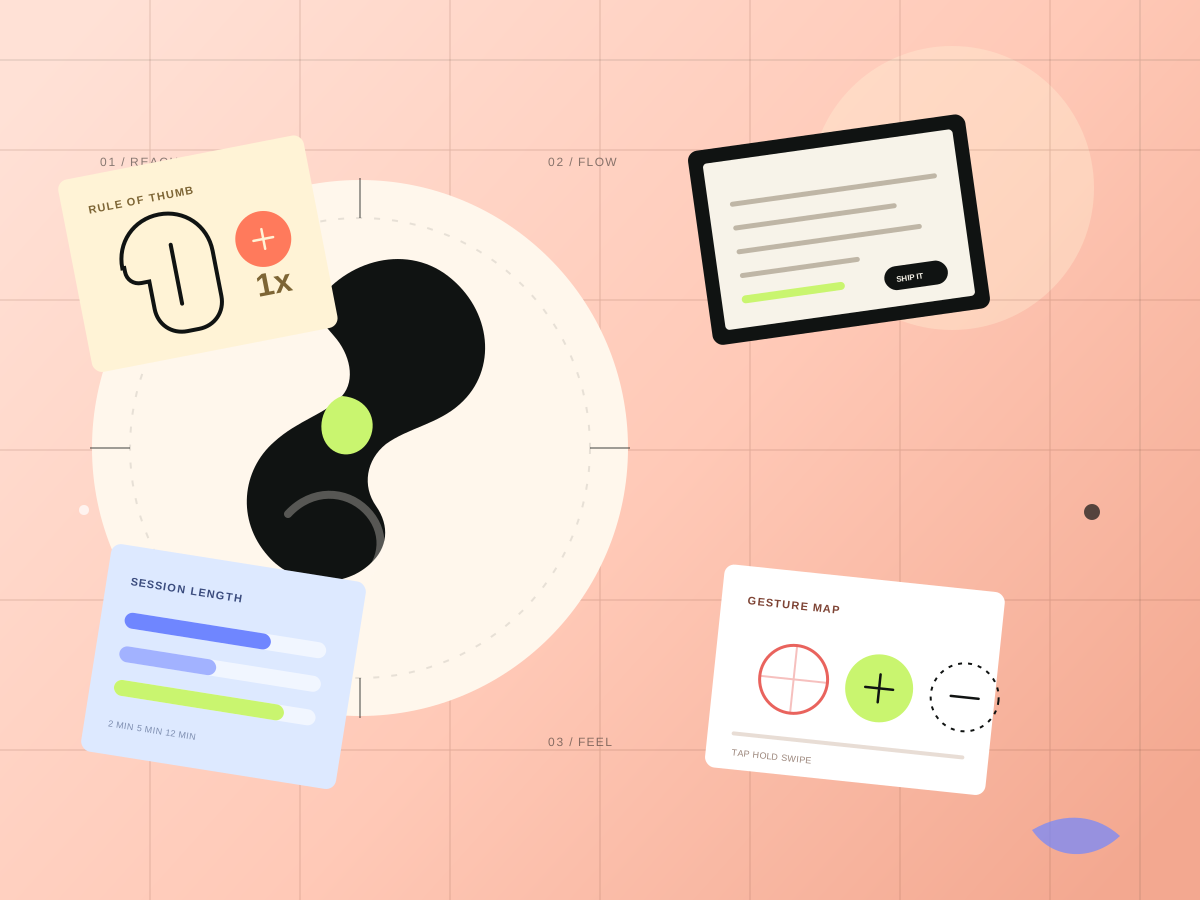
A button can be the right size on a ruler and still be in the wrong place. On a phone, the thumb moves in an arc. The most comfortable area is not the centre of the screen; it is the lower third, close to where the hand already rests.
We test every screen one-handed, with the other hand behind our back. It looks ridiculous. It also catches most of our bad layout decisions before a playtester has to.
Is the response immediate enough to feel causal?
Touch has no hover state. The player presses, and the game answers. If the answer arrives late, the connection weakens. Even a beautiful animation can feel wrong if it starts a few frames after the finger lands.
We aim for a visual response on the same frame as the input, then let the rest of the animation catch up. The first moment is a receipt. The second moment is the personality.
If a player has to wonder whether the game heard them, the interface has already failed.
Does the easing match the feeling?
Linear motion feels mechanical. A slight ease-out feels friendly. A spring can feel playful or unstable depending on the mass. These are not decoration; they are how the game describes its own personality through movement.
We keep a small library of motion curves for each project, then use them consistently. Consistency is what turns a collection of animations into a language.
Is the feedback doing more than one job?
The best feedback confirms the input, communicates the result and adds a little character at the same time. A small scale change, a soft tick of sound, a single frame of light. When those layers align, the interaction feels dense without feeling busy.
When they don't, the screen feels loud. More feedback is not the answer. Clearer feedback is.
Can it survive sound off?
Many mobile sessions happen with the volume down. We test silent builds first. If the core interaction still reads without audio, sound can become amplification rather than instruction.
Would we notice it if it disappeared?
The final test is subtraction. Remove the haptic. Remove the sound. Remove the transition. If the screen still works but feels flatter, the detail was doing real work. If nothing changes, it was probably decoration.
Good interface work is mostly the accumulation of details that are easy to miss and hard to replace.