
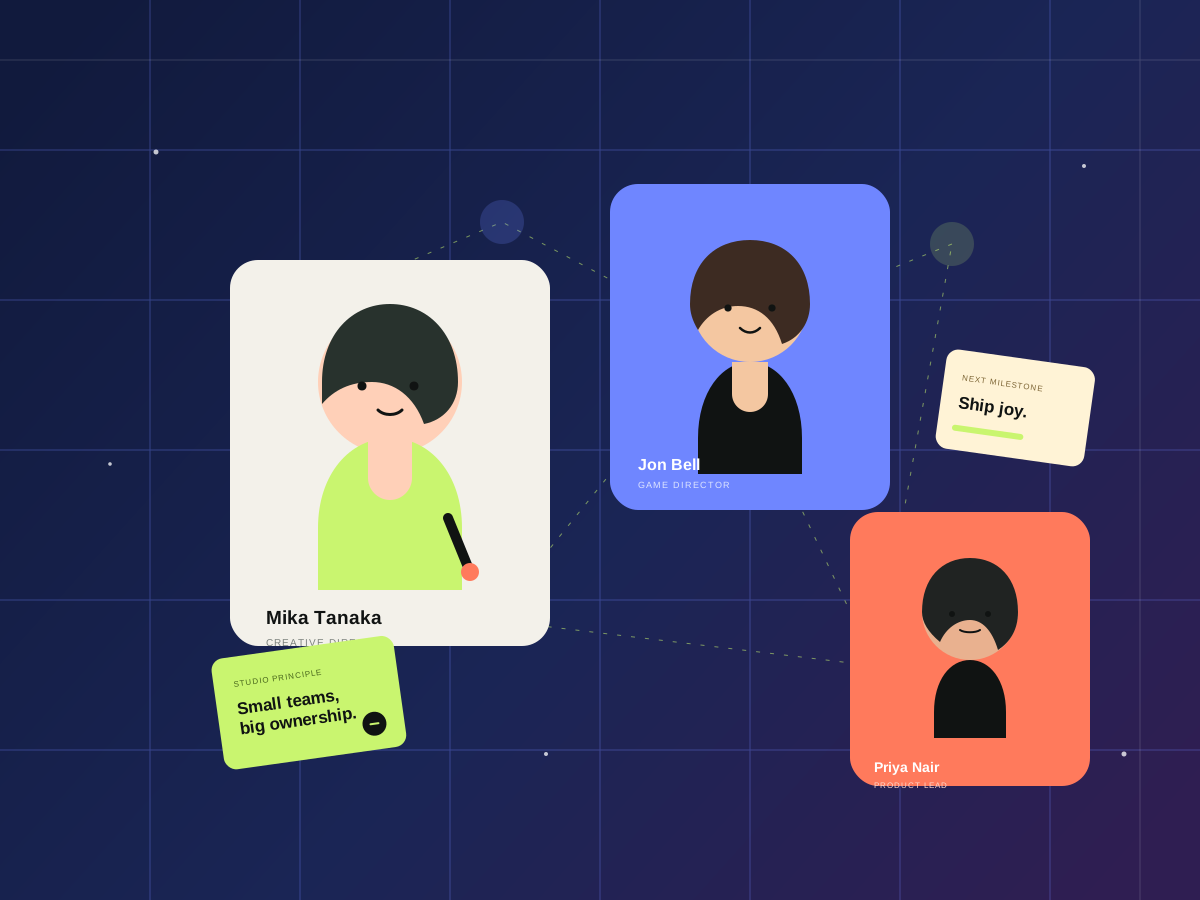
Every year, someone sensible suggests that we should grow. We have more ideas than we can make. We have a queue of things we would like to do properly. Growing would solve that, at least on paper.
We have chosen not to. Not because growth is bad, but because the thing we are trying to protect is fragile: the feeling of a small group of people making a decision together and then making it real.
The cost of a handoff
A handoff is not just a meeting. It is a translation. The person who had the idea explains it to the person who will build it. Details are lost. Assumptions fill the gaps. A week later, someone notices that the thing being built is not quite the thing that was imagined.
In a small team, those translations are shorter. Sometimes they don't happen at all. The designer and the engineer sit with the same problem until it makes sense. The artist sees the interaction before it is built. The producer knows why a detail matters, not just that it is late.
Small teams do not avoid complexity. They keep it close enough to understand.
Ownership is a design tool
When a team is small, everyone can see the whole game. That changes the quality of the work. An engineer who understands the emotional goal of a screen makes different technical choices. An artist who has watched a playtest knows which frame matters.
We try to give each person a clear area of ownership and enough context to make good calls inside it. That is not the same as leaving people alone. It is the opposite: it asks them to care about the result.
Small does not mean slow
People often assume small teams are slower. In our experience, they are faster at the things that matter and slower at the things that don't. Fewer people means fewer parallel workstreams, but it also means fewer meetings, fewer approval layers and shorter feedback loops.
We ship a playable build every two weeks. We play it together. We decide what to cut. The loop is short enough that the game stays one conversation instead of becoming a collection of documents.
The limits are real
Staying small has costs. We cannot do everything. We turn down projects, delay ideas and accept that some things will take longer. We are careful about promising a live-service rhythm we cannot sustain with a small team.
Those limits are useful. They force us to choose. A game that has been chosen carefully is usually better than a game that has simply been resourced.
We will grow when the work asks us to. Until then, we are trying to stay small enough to care about every part of what we make.